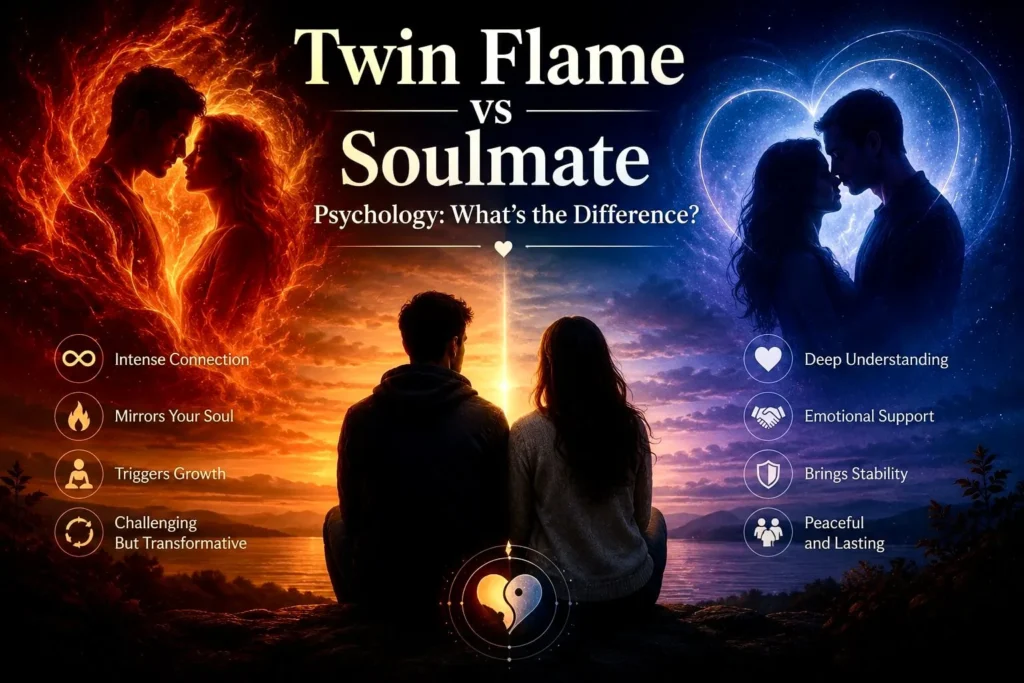
Twin Flame vs Soulmate Psychology explained: discover the key differences, emotional signs, attachment patterns, intense connections, and what psychology says.
Have you ever met someone and felt an immediate connection that was difficult to explain? Maybe you had known them for years even though you had only met recently, or perhaps the attraction felt unusually intense from the very beginning.
Sometimes a person can enter your life and create emotions so powerful that you start wondering whether there is something deeper happening between you. Is this person your soulmate? Is it a twin flame connection? Or are you simply experiencing an unusually strong psychological and emotional bond?
The idea of twin flames and soulmates has become extremely popular because both concepts attempt to explain relationships that feel different from ordinary connections. People often use these terms when describing intense attraction, emotional familiarity, deep understanding, repeated coincidences, difficult breakups, or a feeling that another person has somehow changed their life forever.
However, there is an important distinction between spiritual beliefs and psychological explanations. Psychology does not scientifically establish that people have predetermined twin flames or one perfect soulmate, but it can help explain why certain relationships feel incredibly powerful.
Understanding the difference between a twin flame vs soulmate can therefore be useful, especially if you are trying to understand why you feel so emotionally connected to someone and whether intensity automatically means compatibility.
What Is a Twin Flame?

A twin flame is primarily a spiritual concept rather than a scientifically established psychological phenomenon. According to the popular belief, a twin flame is another person who represents the other half of your soul, creating an unusually intense connection that can bring personal transformation, emotional challenges, and profound self-reflection.
Twin flame relationships are often described as magnetic because the attraction may feel immediate and difficult to ignore. People who believe in twin flames sometimes describe meeting someone and experiencing a strange sense of familiarity, powerful emotional reactions, repeated coincidences, or a feeling that the relationship is forcing them to confront parts of themselves they previously avoided.
The popular twin flame journey is also commonly associated with periods of closeness and separation. One person may pull away while the other continues seeking connection, leading to what is often called the “runner and chaser” dynamic. From a psychological perspective, however, this pattern can sometimes resemble anxious attachment, avoidant attachment, intermittent reinforcement, or an unhealthy relationship cycle rather than evidence of a supernatural connection.
That distinction matters because an intense relationship isn’t automatically a healthy relationship.
What Is a Soulmate?

A soulmate is generally described as someone with whom you share a deep emotional, romantic, or spiritual connection. Unlike the idea that a twin flame is your other half, soulmate beliefs can include the idea that there may be several meaningful people who enter your life at different stages and profoundly influence your growth.
A soulmate connection may feel comfortable, emotionally supportive, and naturally compatible. You might feel understood without constantly having to explain yourself, and conversations may flow easily because your values, personalities, emotional needs, or life goals complement one another.
From a psychological perspective, what people call a soulmate connection may involve emotional compatibility, secure attachment, shared values, mutual understanding, familiarity, attraction, and positive relationship experiences.
This doesn’t make the connection less meaningful. In fact, understanding the psychological reasons behind a strong bond can make the relationship even more fascinating because it shows how deeply human attachment and emotional connection can influence our behavior.
Twin Flame vs Soulmate: The Biggest Difference

The simplest way to understand the difference is this:
A twin flame is usually described as an intensely transformative spiritual connection, while a soulmate is generally described as a deeply compatible and meaningful emotional connection.
Twin flame relationships are often associated with intensity, emotional triggers, separation, reunion, and personal transformation. Soulmate relationships are more commonly associated with compatibility, emotional security, understanding, companionship, and mutual growth.
However, these descriptions are based largely on spiritual and popular relationship beliefs rather than established psychological categories.
Psychology doesn’t officially classify people as twin flames or soulmates.
Instead, psychologists examine things such as attachment, attraction, emotional regulation, compatibility, interpersonal behavior, relationship satisfaction, and patterns of connection.
That means the same experience can sometimes be interpreted in two different ways.
A person might describe an incredibly intense relationship as a twin flame connection, while a psychologist might examine whether the intensity is being influenced by attachment patterns, unresolved emotional needs, idealization, novelty, or intermittent reinforcement.
7 Signs People Often Associate With a Twin Flame Connection
If you’ve been searching for twin flame signs, there are several experiences commonly associated with the concept. Remember that these are spiritual interpretations, not scientifically proven indicators.
1. An Immediate Sense of Familiarity
Some people describe meeting a supposed twin flame and immediately feeling as though they already know the person. The conversation may feel unusually natural, and the emotional connection can appear much stronger than expected for a new relationship.
Psychologically, this feeling can sometimes come from personality similarities, communication style, shared experiences, physical attraction, or a phenomenon sometimes described as rapid emotional familiarity.
2. Extremely Intense Attraction
Twin flame relationships are often described as having an almost magnetic attraction. You may think about the person frequently and feel emotionally pulled toward them even when you are trying to focus on other things.
Strong attraction can be influenced by novelty, reward pathways, physical chemistry, emotional uncertainty, and the anticipation created by inconsistent attention.
Intensity is real, but intensity alone does not prove that someone is your twin flame.
3. Emotional Triggers
Another commonly reported twin flame characteristic is that the relationship brings hidden insecurities to the surface.
You may suddenly become aware of fears around rejection, abandonment, inadequacy, jealousy, or vulnerability. While spiritual interpretations may describe this as the person triggering your soul growth, psychology can understand it through attachment patterns and unresolved emotional experiences.
4. Separation and Reunion
Some twin flame stories involve repeated periods of separation followed by reconnection. The relationship may feel difficult to maintain but equally difficult to completely leave.
Psychologically, repeated breakups and reunions can sometimes create a powerful emotional cycle because uncertainty and intermittent reinforcement can make attention feel even more rewarding.
5. Feeling Changed by the Relationship
People often describe twin flame connections as life-changing. Even if the relationship doesn’t last, they may feel that meeting the person forced them to understand themselves more deeply.
This can happen in many intense relationships without requiring a supernatural explanation. Significant relationships often influence identity, values, boundaries, and emotional development.
6. Strong Emotional Mirroring
You may feel that the person reflects parts of yourself that you normally don’t notice. Their strengths inspire you, while their weaknesses may frustrate you because they remind you of something within yourself.
This is one reason intense relationships can become powerful opportunities for self-reflection.
7. A Feeling That the Connection Has a Purpose
Some people believe that a twin flame enters their life for a specific spiritual purpose, even if the relationship becomes difficult.
From a psychological perspective, humans naturally search for meaning in emotionally significant experiences. Giving a difficult relationship meaning can sometimes help people process what happened and understand how they have changed.
7 Signs of a Soulmate Connection

If you’re comparing twin flame vs soulmate, soulmate relationships are often described as having a different emotional quality.
1. You Feel Emotionally Safe
One of the strongest signs of a healthy deep connection is emotional safety. You don’t constantly worry about where you stand or whether the person will suddenly disappear.
You can communicate honestly without feeling that vulnerability will automatically be used against you.
2. Your Values Are Compatible
Physical attraction can create chemistry, but long-term relationships usually require deeper compatibility. Shared values regarding honesty, family, loyalty, communication, lifestyle, and future goals can make a relationship significantly more stable.
3. Communication Feels Natural
You don’t have to constantly decode the other person’s behavior. Difficult conversations may still happen, but both people are generally willing to listen, explain themselves, and work toward understanding.
4. You Can Be Yourself
A meaningful relationship shouldn’t require you to perform a particular version of yourself to keep someone’s attention.
With a healthy soulmate-style connection, you may feel accepted even when you’re imperfect, emotional, uncertain, or having a difficult day.
5. There Is Mutual Effort
A deep connection is rarely sustainable when only one person is doing the emotional work. Both people contribute time, attention, affection, communication, and effort.
This is an important difference between healthy connection and emotional obsession.
6. Conflict Doesn’t Destroy the Relationship
Every couple experiences disagreement. The important question isn’t whether conflict exists but how both people handle it.
Healthy partners can disagree without constantly threatening the relationship, manipulating each other, or using silence as punishment.
7. You Grow Together
A meaningful relationship doesn’t necessarily make your life perfect, but it can encourage both people to become better versions of themselves while still maintaining their individual identities.
Twin Flame vs Soulmate Psychology: Is Intensity the Same as Love?
This is perhaps the most important question in the entire discussion. No. Intensity and compatibility are not the same thing. A relationship can feel incredibly intense and still be unhealthy.
- You may constantly think about someone because their attention is unpredictable.
- & You may feel obsessed because you never know when they’ll call or disappear.
- You may experience enormous emotional highs when they return after periods of distance.
That doesn’t necessarily mean the connection is destined. Sometimes uncertainty itself creates emotional intensity.
This is one reason people can become deeply attached to relationships that repeatedly hurt them. The occasional moments of affection can feel extremely powerful when they follow periods of emotional withdrawal.
On the other hand, a healthy relationship can initially feel less dramatic because emotional safety doesn’t constantly activate your nervous system.
You may mistake peace for boredom if you’ve become accustomed to emotional chaos. That’s why the better question isn’t: “How intense is this connection?”
A better question is: “How does this relationship make me feel consistently?”
Do you feel respected?
Do you feel emotionally safe?
Can you communicate?
Can you maintain your individuality?
Does the relationship help you grow without destroying your peace?
Those questions tell you far more about relationship quality than intensity alone.
Can Your Soulmate Also Be Your Twin Flame?

According to spiritual beliefs, some people believe that a person can potentially fit both descriptions, while others view twin flames and soulmates as completely different types of connections.
Psychology doesn’t use either category as a formal relationship classification, so there isn’t a scientific test that can determine whether one person is your soulmate or twin flame.
What psychology can help you understand is why a particular person feels so significant.
Attachment style, emotional needs, personality compatibility, shared experiences, physical attraction, familiarity, and relationship dynamics can all contribute to the feeling that someone is uniquely important to you.
So rather than becoming obsessed with finding the correct label, it may be more useful to understand what the relationship is actually doing to your emotional well-being.
Twin Flame or Soulmate: Which Relationship Is Better?
There isn’t a scientifically established answer because neither term represents a formal psychological relationship category.
If you’re looking for a healthy long-term relationship, however, certain qualities matter far more than whether you call someone a twin flame or soulmate.
Look for trust, consistency, emotional safety, mutual respect, honest communication, compatible values, accountability, affection, and reciprocal effort.
A relationship doesn’t need constant drama to be meaningful.
It doesn’t need painful separation to prove that the connection is special.
And someone doesn’t need to be your “other half” for your relationship to become deeply important.
In fact, one of the healthiest relationship beliefs is that two complete people can choose to build something meaningful together without losing themselves in the process.
Why Do Some People Become Obsessed With Twin Flame Connections?

The idea of a twin flame can be particularly attractive when someone is experiencing an unusually intense relationship. Having a label for the experience can make confusing emotions feel easier to understand.
If someone disappears and returns repeatedly, for example, the twin flame concept may provide a story that explains the instability as part of a larger spiritual journey.
But there is a potential downside.
If you believe someone is your destined twin flame, you may start interpreting unhealthy behavior as proof that the connection is special. You might excuse disrespect, repeated rejection, manipulation, or emotional unavailability because you believe the relationship is supposed to be difficult.
That’s where self-awareness becomes essential.
A powerful connection should never become an excuse for accepting harmful behavior.
Destiny is not a reason to abandon your boundaries.
What Psychology Says About Deep Romantic Connections
Psychology offers several useful ways to understand why certain people feel extraordinarily important.
Attachment is one major factor. People develop different patterns of relating to others, and these patterns can influence how they experience intimacy, rejection, closeness, and distance.
Attraction also plays a role. Physical chemistry, emotional compatibility, shared interests, similarity, and perceived familiarity can create strong romantic interest.
Then there is idealization.
When you strongly desire someone, your mind may focus heavily on their positive qualities while minimizing information that contradicts the image you’ve created.
This can make someone seem almost perfect.
Another factor is emotional timing. A person who enters your life during an important transition may become deeply associated with that period of personal growth, making the relationship feel even more significant.
None of this means your feelings aren’t real.
It simply means that powerful feelings can have psychological explanations.
How to Know If a Connection Is Healthy

Regardless of whether you call someone your soulmate, twin flame, life partner, or simply someone you deeply love, pay attention to the actual relationship.
A healthy connection should generally allow you to feel secure enough to be yourself, communicate your needs, maintain friendships and personal interests, and express disagreement without fearing punishment or abandonment.
You should not have to constantly chase someone to receive basic affection.
You should not have to decode every message.
You should not have to tolerate repeated disrespect because you believe the universe has brought you together.
And you should never use the idea of a destined connection to justify staying in a relationship that consistently damages your emotional well-being.
The label matters far less than the behavior.
Final Thoughts: Twin Flame vs Soulmate Psychology

The debate around twin flame vs soulmate psychology is fascinating because it sits between spirituality, romantic culture, and genuine human psychology. Twin flames are generally understood as an intense spiritual connection associated with transformation and emotional challenges, while soulmates are often described as deeply compatible people who create a meaningful sense of emotional connection and understanding.
Psychology doesn’t scientifically confirm that people have predetermined twin flames or one destined soulmate, but it does provide powerful explanations for why certain relationships can feel unusually intense. Attachment, attraction, compatibility, emotional familiarity, idealization, uncertainty, and shared experiences can all influence how deeply we connect with another person.
Ultimately, you don’t need a mystical label to prove that a relationship matters.
The most important question isn’t whether someone is your twin flame or soulmate.
It’s whether the relationship allows you to experience love without losing yourself, intimacy without fear, and connection without sacrificing your emotional well-being.
A relationship that brings peace, respect, honesty, growth, and mutual effort may be far more valuable than one that simply feels impossible to resist.
Sometimes the deepest connection isn’t the one that turns your entire life upside down. Sometimes it’s the one that finally makes you feel safe enough to be completely yourself.
If you’re interested in understanding male psychology, emotional attraction, and what can make a man become deeply emotionally invested, you may also want to explore His Secret Obsession. It takes a deeper look at the emotional side of attraction and relationship dynamics, which can give you another perspective on why certain connections feel so powerful.
Remember, whether you call someone a twin flame, soulmate, or simply a deeply meaningful connection, the healthiest relationship is one where attraction and emotional intensity exist alongside respect, consistency, communication, and genuine care. You should never have to lose your peace, boundaries, or sense of self just to prove that a connection is special.
Frequently Asked Questions
You might also find these guides helpful
- How to Get Him to Open Up Emotionally: 15 Proven Ways
- How to Know If Someone Loves You But Is Scared
- Why Do Average Girls Make Everyone Obsessed? 13 Psychology
- Why Men Lose Interest in Relationships And How to Prevent It
- 15 Signs He Wants a Serious Relationship With You
- How to Make Him Feel Emotionally Safe Around You
- How to Trust Again After Betrayal: 11 Healing Steps
- Silent Treatment Psychology: Why People Ignore You
Pingback: What Makes a Woman Irresistible? 15 Psychology Secrets
Pingback: How to Get Inside Any Man’s Mind: 13 Psychology Secrets
Pingback: Psychology of Eye Contact in Love: What It Really Means